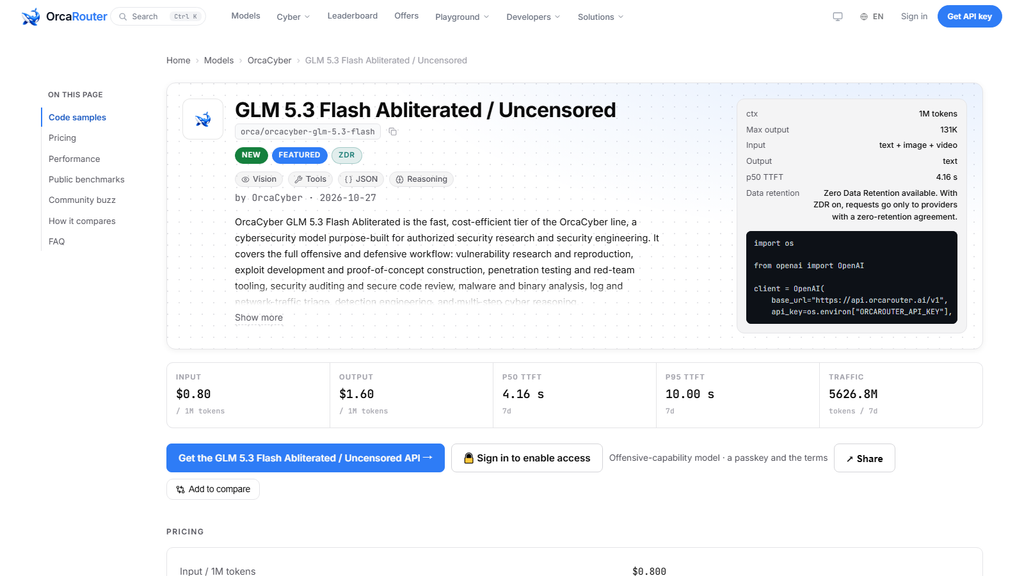
Ninety-two is what this card scores on SWE-bench and 67.9 is what it scores on CyberBench, and the 24-point gap is the most informative thing in its benchmark block. OrcaRouter publishes all five rows as evaluated scores. They sit on OrcaCyber GLM 5.3 Flash benchmarks.
The block
| benchmark | score | what it measures |
| SWE-bench | 92.0 | repository-level repair |
| GPQA Diamond | 91.2 | graduate-science reasoning |
| Terminal-Bench 2.1 | 84.3 | verified terminal tasks |
| LiveCodeBench | 80.5 | competitive programming |
| CyberBench | 67.9 | security-domain work |
All five are vendor-reported. Four sit between 80.5 and 92.0 — a 11.5-point band — and the fifth sits 12.6 points below the lowest of them.
That shape is worth reading carefully. A model that scores in the low nineties on repository repair and graduate science, in the mid-eighties on verified terminal tasks, and in the low eighties on competitive programming is a strong general coding model. The 67.9 says the same model is materially weaker on security-domain work.
Which makes this an unusual card on a security tier: it is the strongest general coder in the tier by its own published rows, and the weakest of the four cards that publish a cyber-specific test.
Where 67.9 sits among the cyber scores
| card | cyber-specific row | score |
| Zero 1.0 | CyberGym Level 1 pass@1 | 98.07 |
| MiMo V2.6 Flash | CyberGym | 95.1 |
| Flash 1.0 | CyberGym | 88.1 |
| Hy4 Flash | CyberGym | 81.1 |
| GLM 5.3 Flash | CyberBench | 67.9 |
Five cards publish a security-domain row and this card’s is the lowest by 13.2 points. Two caveats belong beside that table.
First, CyberBench and CyberGym are different tests, so the numbers are not commensurable. Four of the five rows are CyberGym; this card’s is not. Comparing 67.9 to 88.1 is a comparison of two instruments rather than two models.
Second, a card can score low on a domain test and still be the right tool. A 92.0 on SWE-bench says the card repairs real repositories well, and much security work is repository work — dependency patching, configuration hardening, test coverage for a vulnerable function. CyberBench may be measuring something narrower.
Still, the row is the card’s own published choice. If CyberBench were not the test its vendor wanted quoted, it would not be on the card.
The general-coding argument, in numbers
Take the four non-cyber rows and compare them with the other cards that publish the same tests.
| test | GLM 5.3 Flash | others |
| GPQA Diamond | 91.2 | Flash 1.0 90.9 · Qwen3.8 Flash Next 91.7 · MiniMax M3.1 Flash 88.6 · MiMo V2.6 Flash — · Hy4 Flash 83.6 |
| LiveCodeBench | 80.5 | Qwen3.8 Flash Next 91.9 (v6) · Flash 1.0 — |
| SWE-bench | 92.0 | Zero 1.5 76.5 (Pro V2) · Qwen3.8 Flash Next 62.5 (Pro) · Flash 1.0 74.2 (DeepSWE v1.1) |
| Terminal-Bench 2.1 | 84.3 | Flash 1.0 90.6 · MiMo V2.6 Flash 87.6 · Hy4 Flash 83.4 |
The GPQA row is comparable across five cards and this card sits third, within 5 points of the leader. The Terminal-Bench row is comparable across four and this card is third again.
The SWE-bench row is not comparable — three different variants are in play — and the LiveCodeBench row is not either, because this card’s is the base version and Qwen’s is v6.
So the general-coding case rests on two comparable rows where the card is consistently third of four or five. Strong, not leading. That is a different claim from “the best coder in the tier”, and the published fields only support the weaker one.
What a buyer should do with five rows
Three readings, and the block supports each.
Read the domain row. 67.9 on a security benchmark is a low number and a buyer whose work is CyberGym-shaped should weigh it heavily.
Read the general rows. 92.0 on repository repair is a high number and a buyer whose work is patching, hardening and testing should weigh that.
Read the shape. Four rows in an 11.5-point band and one 12.6 below is a model with a specific weakness rather than a uniformly mid-tier model. That is more useful than a single average, which would land near 83 and describe nothing.
The one thing the block cannot support is a claim about how the card compares to the four CyberGym-scoring siblings on any shared test, because no shared test exists. That absence is itself a finding worth stating: a tier of five cards publishing security scores has only one test in common, and it covers four of them.
Why a 92.0 and a 67.9 can both be true
Two scores from one card, twenty-four points apart, measuring different things about the same model.
| row | score | task horizon | endpoint |
| SWE-bench | 92.0 | long, multi-file | a merged patch |
| GPQA Diamond | 91.2 | short, single question | one answer |
| Terminal-Bench 2.1 | 84.3 | medium, verified steps | a task script |
| LiveCodeBench | 80.5 | short, single problem | one program |
| CyberBench | 67.9 | domain-specific | a domain verdict |
Four of the five decline as the task moves from generic to domain-specific, and the one that breaks the pattern is SWE-bench at the top.
That ordering is the argument. This is a model that performs best on general software engineering and worst on security-domain questions, which on a security tier is an inversion.
Whether CyberBench is a fair instrument nobody outside the vendor can say. What can be said is that it is the row the vendor chose to publish, that it sits on the card as an evaluated score, and that it is 24.1 points below the same card’s best row.
A buyer who ignores it is choosing the four rows that suit the card. A buyer who ignores the other four is choosing the one that does not. The block is only useful read whole.
One asymmetry in the block is worth naming. On the two rows where the card leads its band siblings — SWE-bench at 92.0 and GPQA at 91.2 — the tests are general. On the one row where it trails every published sibling, the test is specific to the domain the tier exists for. A buyer reading only the leading rows would conclude the card has the strongest evidence base on the band, and would be reading a block that reverses underneath the one test that matters most here.
OrcaCyber GLM 5.3 Flash publishes five evaluated rows: SWE-bench 92.0, GPQA Diamond 91.2, Terminal-Bench 2.1 84.3, LiveCodeBench 80.5 and CyberBench 67.9 — four inside an 11.5-point band and one 12.6 points below it.
The 67.9 is the lowest security-domain score in the tier by 13.2 points, though four of the five cards publishing such a row use CyberGym rather than CyberBench, so the numbers are not commensurable. On the two rows that are comparable across five cards the card sits third, which supports strong rather than leading.
Sourcing note: all five benchmark scores, the throughput, error rate, price rows, cache rate and capability fields are read from the OrcaCyber GLM 5.3 Flash model API and card page on orcarouter.ai on 2026-11-20, with throughput and error rate being OrcaRouter production telemetry for the seven days to that date. The bands, gaps and cross-card comparisons are our own arithmetic on published rows. All benchmark scores are vendor-reported and have not been independently reproduced; benchmark names and variants differ between cards and are not treated as commensurable. No competitor product is named or compared. Checked 2026-11-20.